REHEARSED: The Quiet Theatre of the Self
There is something quietly theatrical about the way we move through the world.
A gesture, a pose, a carefully chosen image, the version of ourselves we decide to present before entering a room (or before posting online). Performance has never belonged only to the stage. It is something inherently human, present in the way we dress, speak, look, behave, and construct meaning around who we are. Today, however, the rise of social media and the culture of constant visibility have made these everyday performances feel more present than ever.
This is the tension at the heart of REHEARSED, the upcoming group exhibition by Ulstrup Gallery in Copenhagen, curated by Stine Ulstrup Jensen.
Bringing together works by Kristoffer Bech, Malwine Staus, Olga Krykun, and Jonas Mayer, the exhibition explores how performance extends beyond theatrical space and into the visual language of identity, self-presentation, symbolism, and illusion.
One sentence from the exhibition’s text stayed with us: “their function is to maintain the illusion.”
It feels almost too relevant to the cultural moment we are living in. In an age where identity is constantly curated, where the self is edited, repeated, rehearsed, and performed across both physical and digital spaces, illusion is no longer something separate from reality. Sometimes, it is the structure that holds it together.
Through painting and sculpture, the artists seem to question what is natural and what is staged, what is authentic and what is carefully maintained. The exhibition becomes less a static display and more a scene in progress: a space where artworks hold a role, viewers become witnesses, and meaning appears somewhere between surface and gesture.
For DEPLÜME, REHEARSED opens a conversation about art, image-making, and the many roles we play: consciously or not.
We spoke with Stine about the fil rouge connecting the artists, the viewer’s role inside the exhibition, and what performance can reveal about authenticity in a world increasingly shaped by visibility.
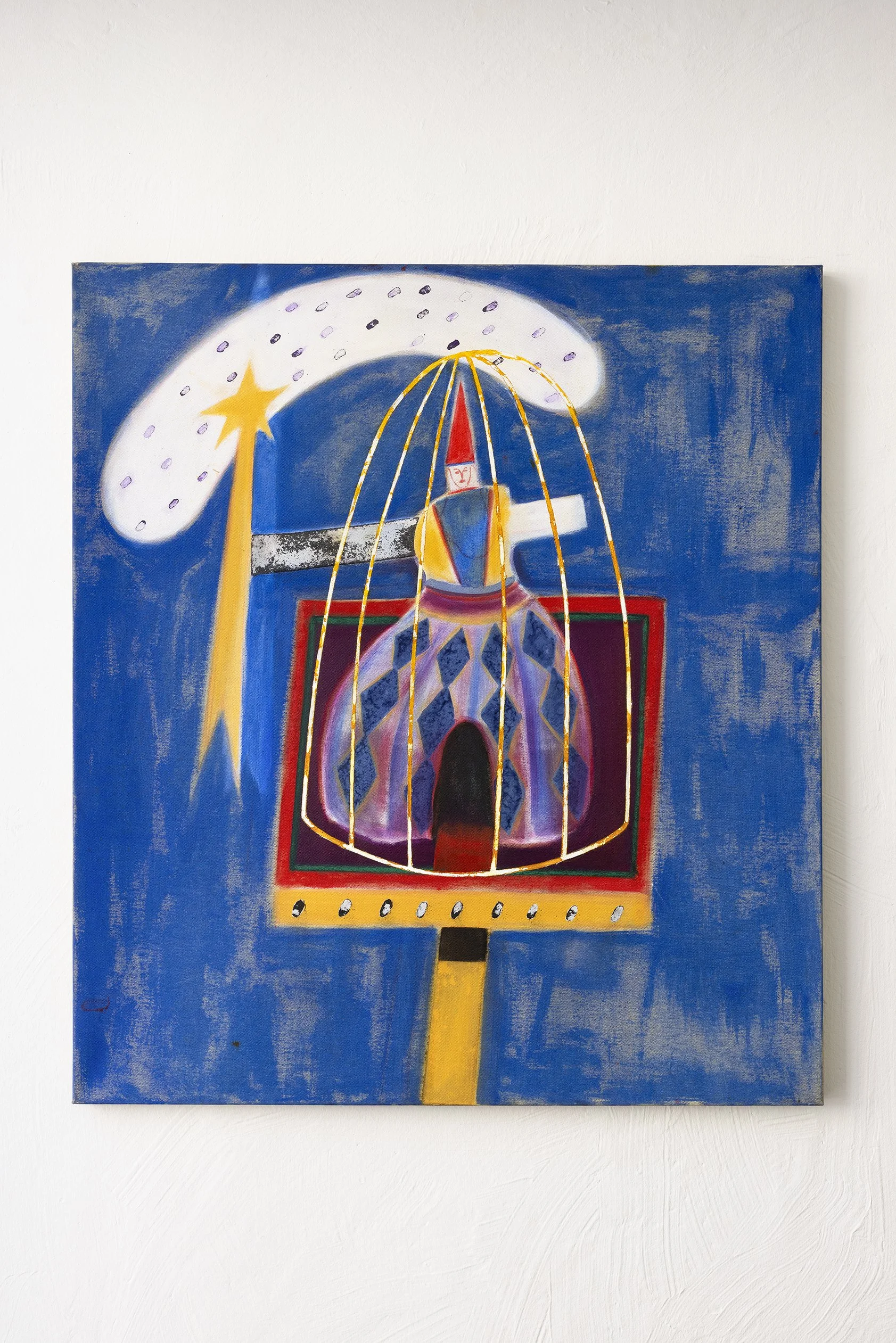
Jonas Mayer — Käfig (2023)
What is the fil rouge that connects the different artists in REHEARSED?
The selected artists, Kristoffer Bech, Olga Krykun, Malwine Stauss, and Jonas Mayer, each in their own way, work with characters. These characters become part of a “performance” within the context of REHEARSED, where they each bring their own emotional baggage and become part of a performance that unfolds between the works, spanning various forms of expression and narratives.
Both Kristoffer Bech and Olga Krykun also have professional backgrounds in the performing arts, including music, theater, and film. Furthermore, all the artists in REHEARSED are children of the ’90s, and performativity is therefore interpreted in light of social media’s growing influence on our identity and self-presentation. The artists are thus able to draw connections between the stage and human interaction, as well as digital performativity, making their interpretation of the subject particularly personal and powerful within the framework of REHEARSED.
How do the artworks invite the viewer into the performance: as a spectator, a participant, or simply as someone observing from the outside?
At first glance, the works invite the viewer into a world of entertainers who captivate with their spectacular colors and shapes. Once they have drawn you into this world, however, you are surprised by what it has to offer, as the characters in REHEARSED confront us with the emotional sides of characters whom we normally recognize only for their performance.
The phrase “their function is to maintain the illusion” feels very powerful in relation to the exhibition. How does this idea connect to the works presented in REHEARSED, and to the broader tension between authenticity and performance in arts?
In an entertainment setting, such as a theater performance or a circus show, the performers are reduced to the roles they play in the show. In this context, they are not recognized as individuals with feelings and opinions. This is the premise on which the performance takes place. The audience comes to be entertained and perhaps even distracted from the outside world, and therefore it is the clown’s and the acrobat’s task to maintain the illusion that they are always the cheerful clown and the active acrobat. This becomes a powerful symbolism for the consequences of performance and self-presentation when we shift the context and move beyond the stage and into everyday life.
In REHEARSED, the works present characters that disrupt the performance expected by these characters, and at the same time, they represent each of us when we are reduced to our social roles and the expectations of the outside world, rather than being our authentic selves. A perspective that is relevant both in the art world and in society as a whole.
How do you think the theme of performance in REHEARSED connects to the way we present ourselves on social media today?
There’s no doubt that the theme of REHEARSED and our use of social media are closely linked.
If you use social media, it’s to send a signal to the outside world, whether you’ve posted a selfie, a sunset, or a picture of your dog. Everything we post on social media becomes an identity marker that’s meant to reflect how we want the outside world to perceive us, or how we perceive ourselves. It has even become an identity marker to be “the kind of person who doesn’t post on social media.” Thus, our use of social media becomes our individual stage where we can express ourselves, but it is also a place where we can curate what we want to show the outside world, and so this layer of performativity undeniably enters into the use of social media.
To close the conversation, we also asked the artists how their own work in REHEARSED relates to the ideas of performance, illusion, and self-presentation.
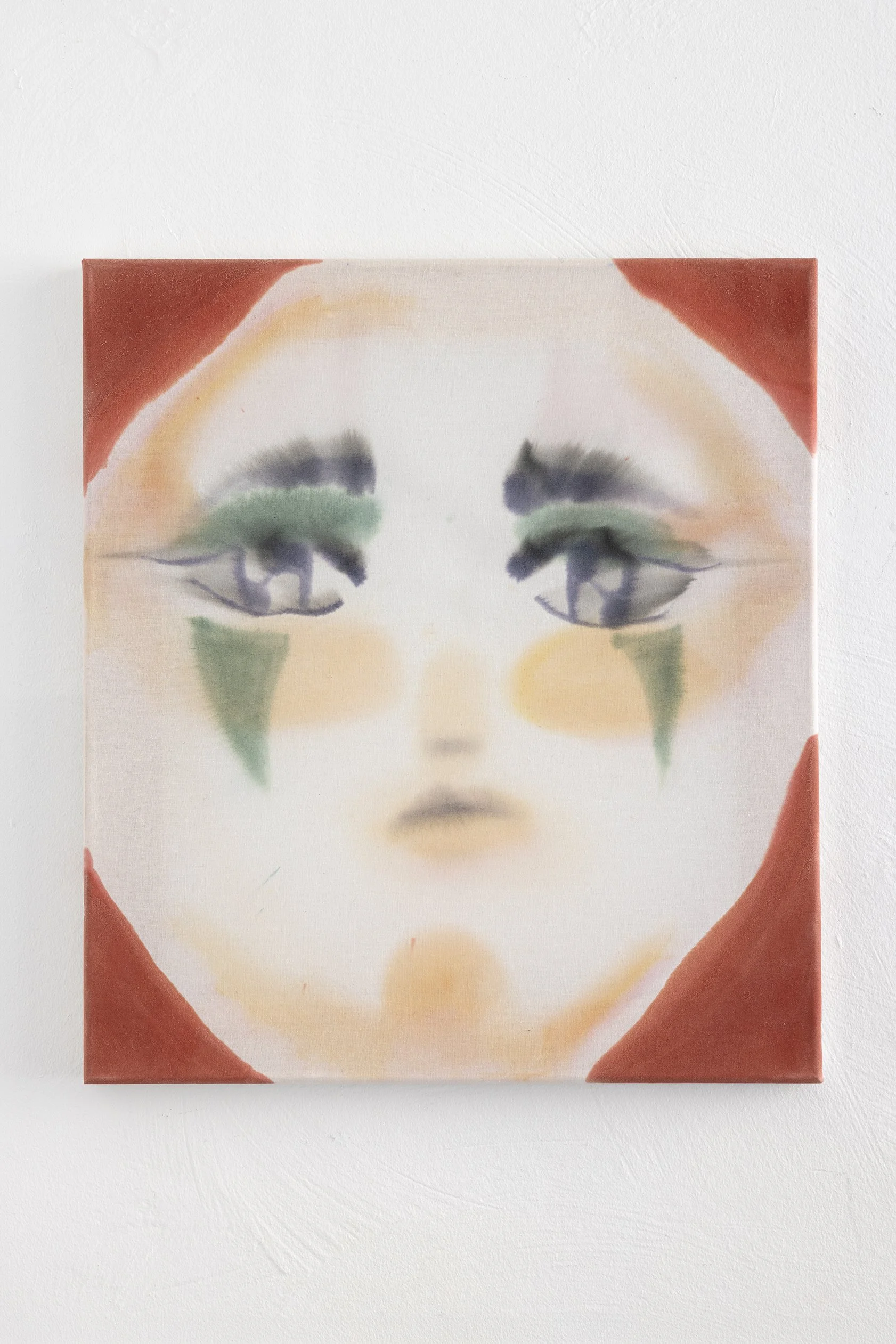
Olga Krykun — E-girl Melancholia 05 (2021)
For Olga Krykun, the idea of rehearsal appears not only in the subject of the work, but also in the act of painting itself:
“My paintings for REHEARSED reflect the process of preparing for something uncertain and unresolved. I approach painting through intuition, repetition, revision, and moments of failure, allowing the image to constantly shift during its creation. Working with large amounts of water creates a tension between controlling the process and being controlled by it, where layers, corrections, and unstable forms reveal the vulnerability behind trying to construct a convincing image or narrative.”
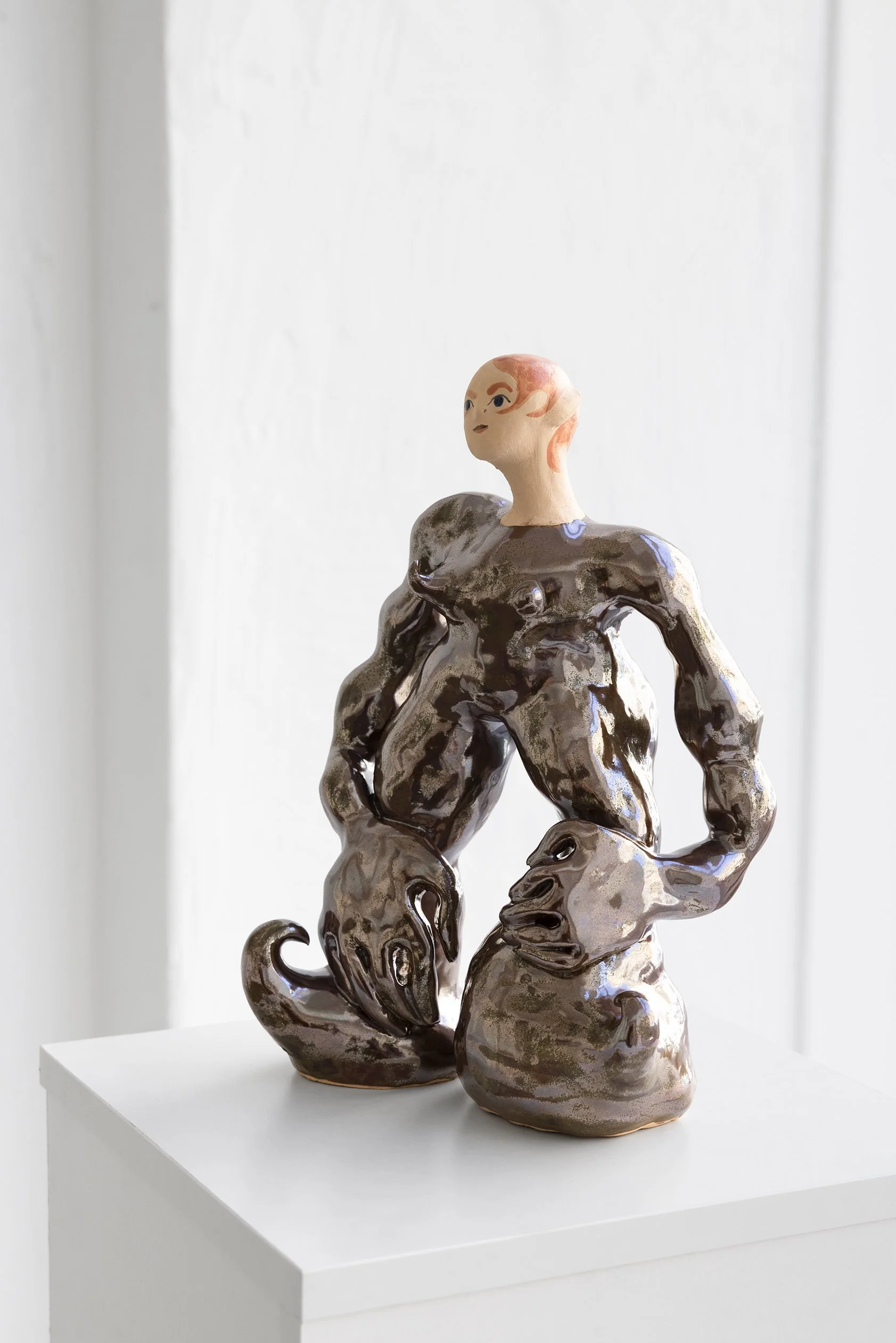
Malwine Stauss — Ursula (2025)
For Malwine Stauss, performance becomes a way of making internal processes visible through colour, form, material, and costume:
“I like to work with the possibilities of making internal processes visible. For that, I use different tools like colour, form, and materials. I play with costumes for the characters I’m creating and try out different ways in which their surfaces can convey internal or invisible processes.”
In the end, REHEARSED does not treat performance as something artificial or distant. It brings it closer, into the everyday gestures, images, roles, and surfaces through which we become visible to others.
Between painting and sculpture, spectacle and vulnerability, the exhibition asks us to look again at the characters we encounter, and perhaps at the ones we perform ourselves.
Because sometimes, the most revealing moment is not the performance itself, but the instant when the illusion begins to slip.