THE INSPIRATION ISSUE - HILMA AF KLINT
She painted for a future that was not ready. Now the future is finally looking.
The question my art history class could not answer
During my second year of university, I took a course called Philosophy of Art II, still, to this day, one of the most interesting classes of my entire degree.
As part of the final evaluation, besides a gigantic exam (and anyone who went to Bocconi will understand the emotional weight of the word gigantic) we also had to write a paper on one of the so-called “fathers of abstraction”: Mondrian, Kandinsky, Malevich…
I chose Malevich.
I had always been fascinated by his approach to abstraction: the severity of his forms, the radicality of his thinking, the idea that painting could slowly detach itself from the visible world and become something more internal, more philosophical, almost spiritual.
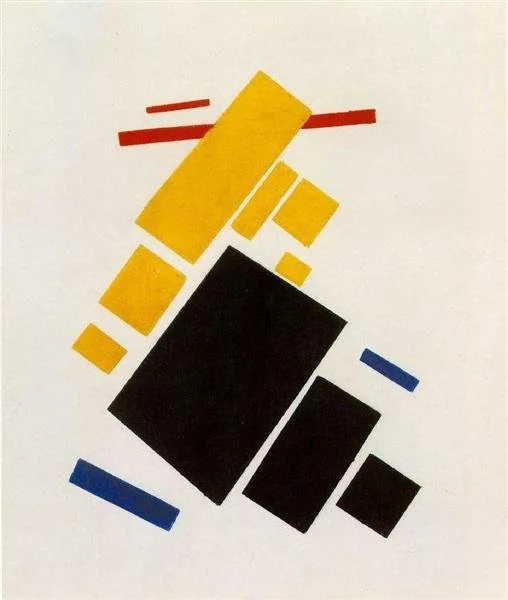
Suprematist Composition: Aeroplane Flying, 1915, Kazimir Malevich
So I spent hours in the library reading about him, taking notes, underlining pages, trying to understand what was hidden behind those black squares, those sharp geometries, those paintings that seemed to move further and further away from reality.
his was, of course, before ChatGPT existed, so when I say “research,” I mean the full old-school version: books, library silence, mild despair, and too many coffees.
But the more I read, the more one question kept coming back to me.
How was it possible that in an artistic movement so connected to spirituality, imagination, intuition, freedom, and play, there was not a single woman among the great founders?
Not one?
It did not make sense to me.
Abstraction was supposed to be about moving beyond the visible. Beyond rules. Beyond the literal. Beyond the world as it had always been represented.
And yet, somehow, the story I was being taught still looked exactly like the old world: men, men, men, and more men. So I started digging.
And somewhere between the university books, footnotes, and the kind of research rabbit hole that begins innocently and ends three hours later with twelve open tabs, I found her.
A woman who does not always appear in the manuals.
A woman who painted abstraction before many of its so-called fathers.
A woman who created for a future that was not ready to understand her yet.
That was how I discovered the unknown mother of modern abstraction:
Hilma af Klint.
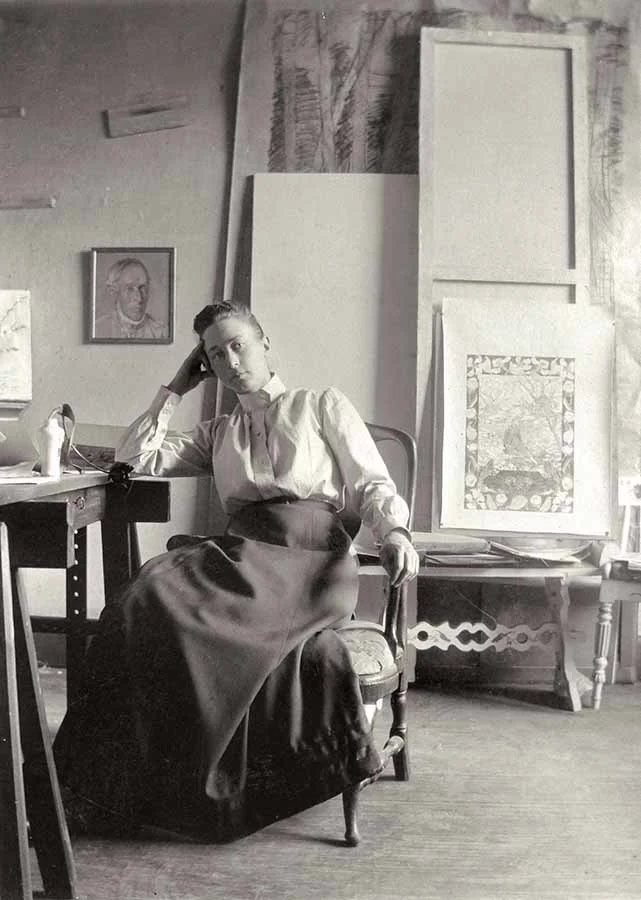
Hilma af Klint in her studio, early 20th century
Welcome to “the inspiration issue”
And it is with her that we have decided to launch our new series, The Inspiration Issue.
Because Hilma represents exactly the kind of story we want to tell.
Not inspiration as a pretty quote saved on Pinterest or as a vague moodboard word (not that there’s anything wrong in that). But inspiration as something that changes the way you look at the world.
The Inspiration Issue is about people, artists, thinkers, movements, and creative spirits who dared to go against the current. People who followed an inner vision even when no one else understood it. People who were too strange, too early, too intense, too radical, too free... until one day, history finally caught up with them.
These are the stories we want to collect. The ones that make us braver. The ones that make us rethink what we were taught.
The ones that remind us that being misunderstood is not always a sign that you are wrong... sometimes, it means you are early.
And Hilma af Klint is exactly that.
She once believed that the world was not ready for her art... but let’s not get ahead of ourselves.
Let’s start at the beginning. So pause the chaos for a few minutes, stop the scrolling, and come with us into one of the most extraordinary stories in modern art.
Hilma af Klint - A Life Between the Visible and the Invisible
Hilma af Klint was born in Sweden in 1862, into a family connected to the sea, navigation, and maps. Her father was a naval officer, and she grew up surrounded by a world of observation, precision, nature, and systems (things that would later quietly reappear in her art).
She was born at a time when Sweden, like much of Europe, was changing fast. Science was advancing, cities were modernizing, and old social structures were slowly beginning to shift. For women, life was still deeply restricted, but something was starting to move. In 1863, when Hilma was still a child, unmarried women in Sweden gained legal majority at the age of twenty-five, meaning they could live with more independence and no longer remain permanently under male guardianship.
It was not equality, of course. Not even close, but it mattered.
It meant that a woman like Hilma could imagine a life that did not necessarily revolve around marriage. She never married. She chose work, study, art, and spiritual research instead.
And from early on, her family supported her artistic path.
She studied first at the Technical School in Stockholm, then at the Royal Academy of Fine Arts, where she trained in portraiture, landscape painting, and botanical drawing. In 1887, she graduated with honors , as a serious, academically trained artist.
At the beginning of her career, Hilma painted the kind of works the world expected from her: landscapes, portraits, botanical studies. And she was very good, she was respected, she was considered professional.
But that was only one side of her.
Because while the public saw the respectable artist, another Hilma was forming in private.
Painting the world underneath the world
At the end of the nineteenth century, many artists and intellectuals were becoming fascinated by spiritualism, theosophy, séances, invisible energies, and all the things that modern rationalism could not fully explain. It sounds mystical now, maybe even eccentric, but at the time it was deeply connected to the cultural atmosphere of the period. Science was discovering invisible forces — electricity, radio waves, X-rays, so why couldn’t art also become a way to explore what could not be seen?
For Hilma, this was not a side interest: it became central to her life.
In 1896, she formed a spiritualist group with four other women called The Five. They met regularly, held séances, practiced automatic writing and drawing, and believed they could receive messages from higher spiritual beings.
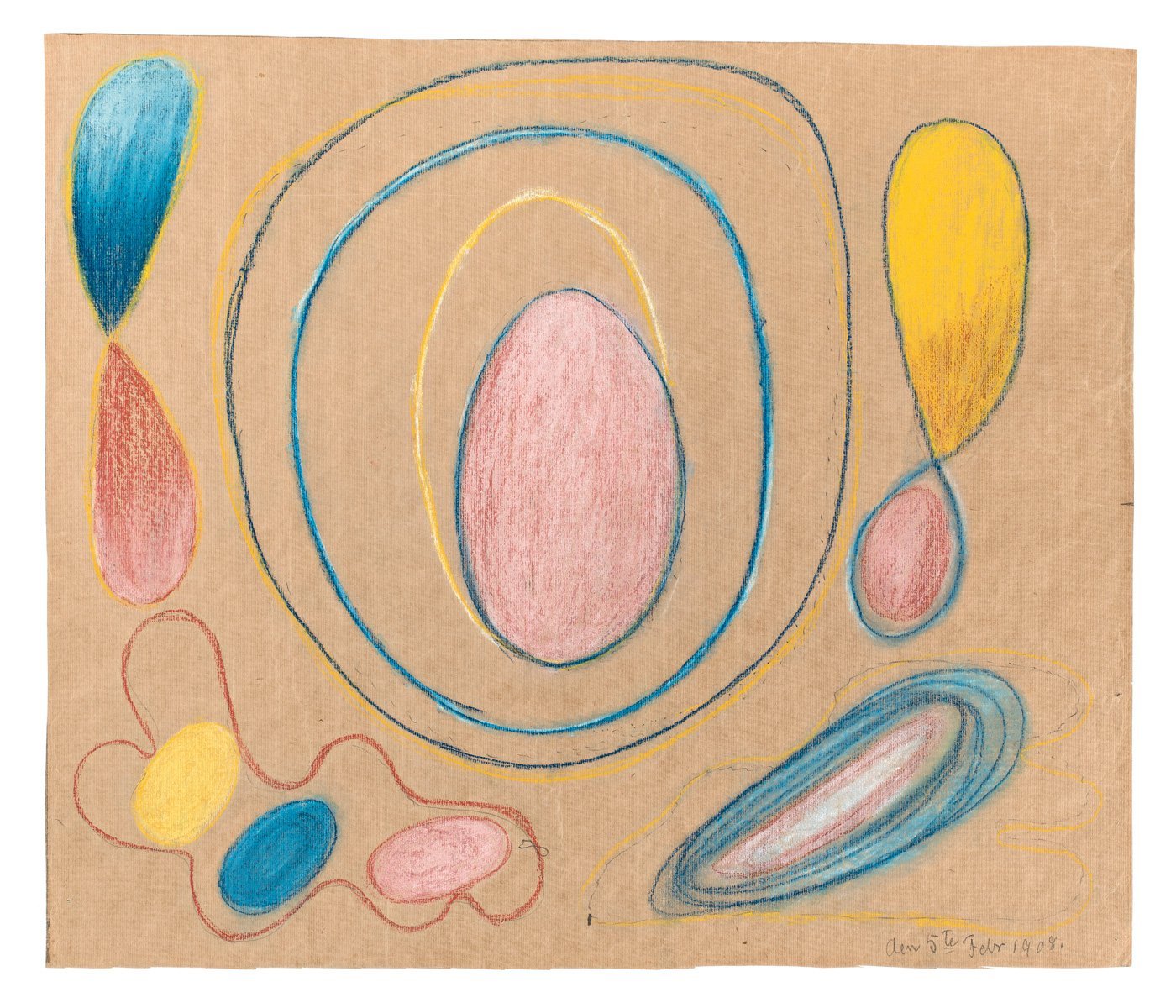
“Automatic drawings” by The Five, Untitled 1908
And this is where her art begins to become something else entirely.
Not a landscape, not a portrait, not a painting of the world as it appeared: but a painting of the world underneath the world.
In 1906, Hilma af Klint began working on what would become her most important body of work: The Paintings for the Temple.
These paintings were unlike anything she had shown publicly before. They were filled with spirals, circles, flowers, letters, symbols, diagrams, radiant colors, and strange forms that seemed to belong to both the future and the ancient past.
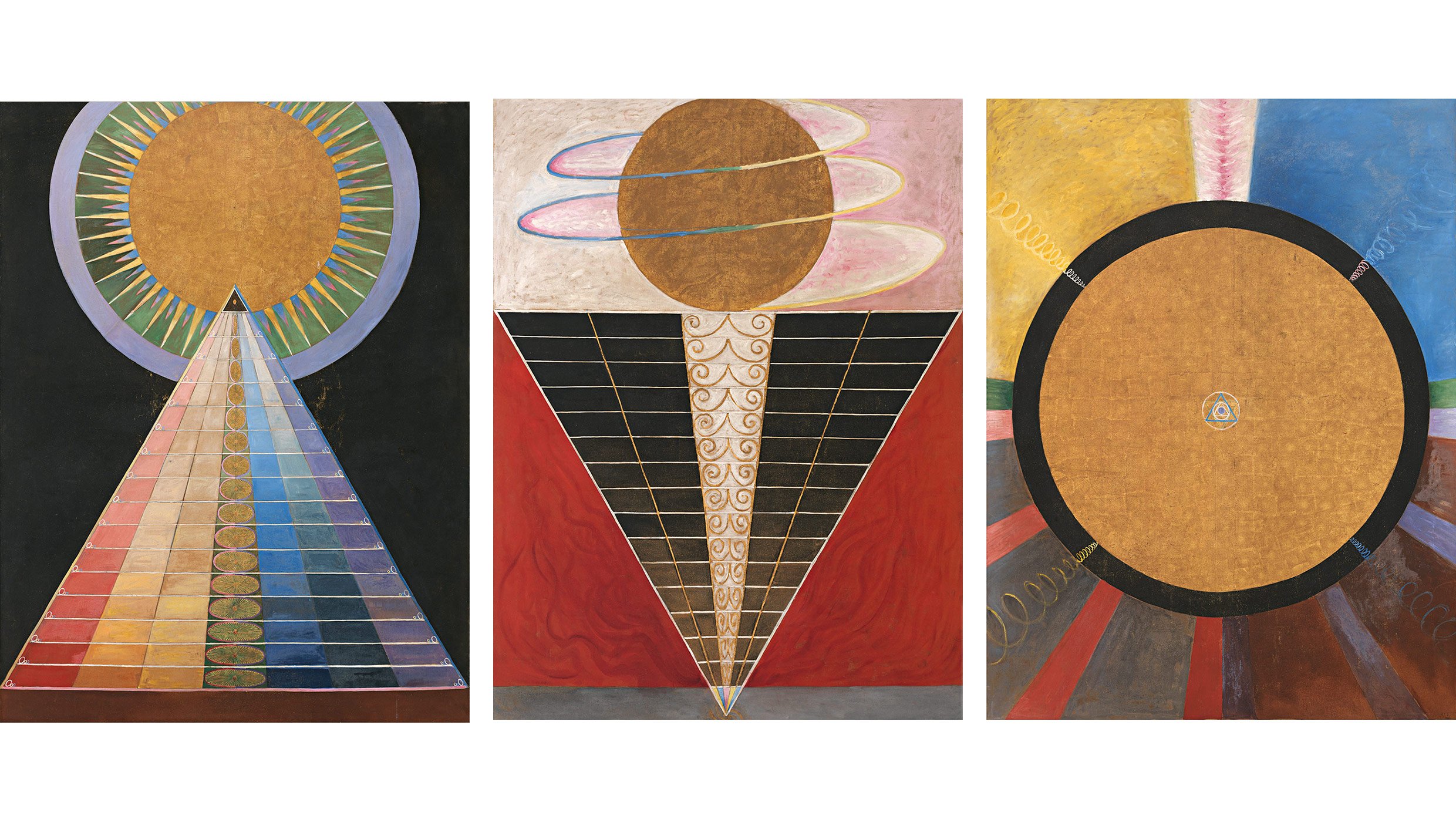
Pantings for the Temple, specifically “Group X, No. 1, Altarpiece,” 1915 “Group X, No. 2, Altarpiece,” 1915 and “Group X, No. 3, Altarpiece,” 1915
They were abstract before abstraction had officially entered the art history books,and she made them mostly in secret.
While the world would later celebrate men like Kandinsky, Mondrian, Malevich, and Kupka as the pioneers of modern abstraction, Hilma had already begun creating a visual language that was radically her own.
But she did not chase recognition, nor she tried to explain herself into acceptance as she believed her audience did not exist yet.
So she painted for the future.
Painting as a language
For Hilma, painting was not just painting. It was a transmission system.
She believed she could make the unseen visible: energies, messages, spiritual forces, the architecture of a world that existed beyond the surface of things. Every line, every symbol, every color became part of a language. A stroke was not only a stroke. It was a word, a sentence, a signal from somewhere higher.
This is also where her abstraction feels so different from someone like Malevich.
Malevich’s abstraction feels like a radical reduction: the world stripped down to pure form, geometry, and idea. Hilma’s abstraction feels like expansion: a universe opening, blooming, speaking in symbols, flowers, spirals, and colors.
One removes the world to reach the absolute, the other paints the invisible world that was already there.
And maybe this is why her work moves me so much.
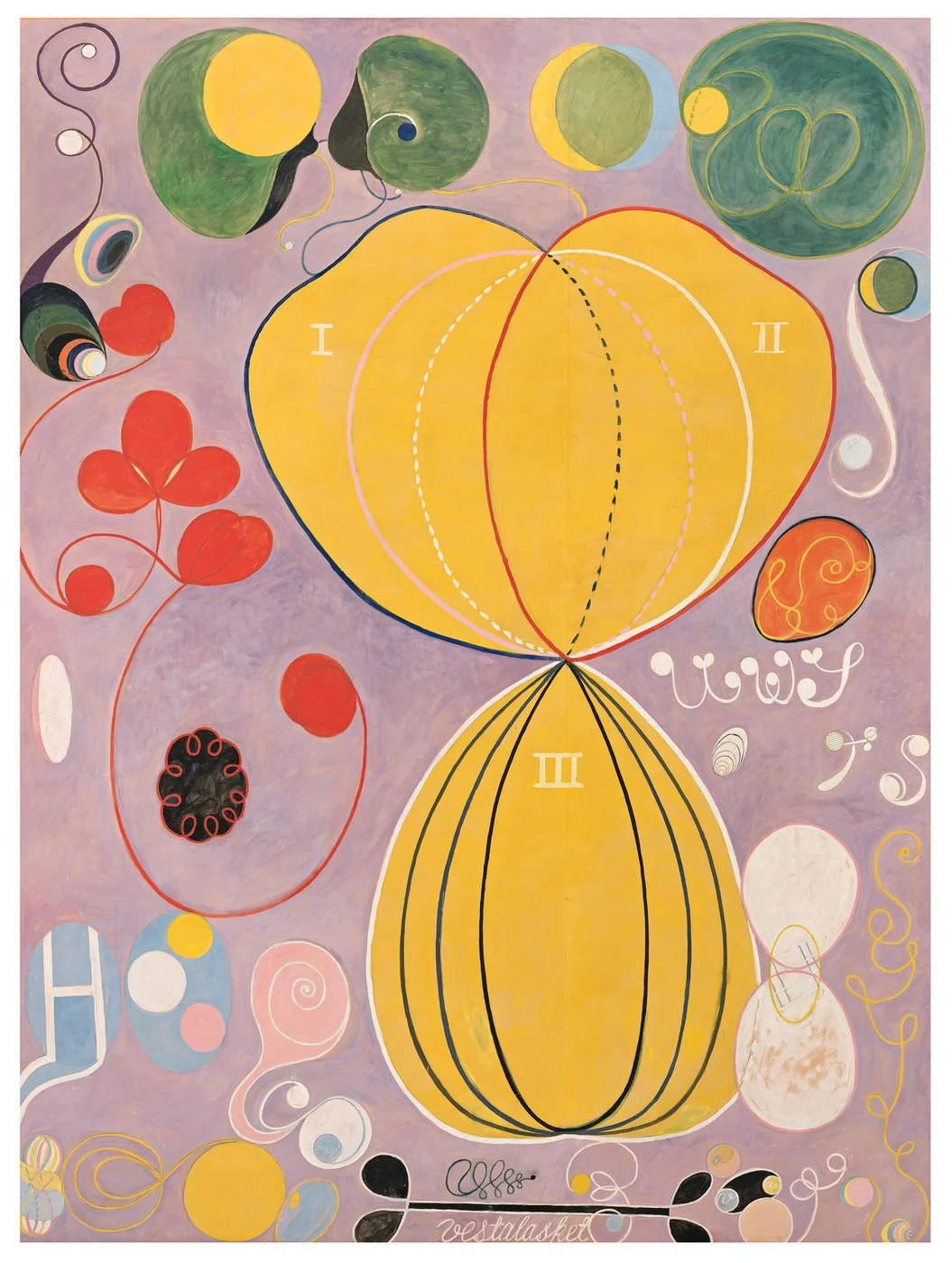
Hilma af Klint Group IV, The ten largest, no 5, adulthood 1907
She painted and painted and painted because it was an extension of herself, it was not content nor it was strategy. It was intimate, private, almost secretive. It belonged to her before it belonged to anyone else. And I think this is the most beautiful part of her story.
Hilma was not creating because the world was clapping, the world was not even looking. She was not making work to be understood immediately, praised instantly, or validated publicly. She was following something that felt true to her, even if no one around her could fully understand it yet.
Honestly, we should all think a little more like Hilma.
Not in the sense that we should all disappear into mystical visions and start painting giant spiritual diagrams (although, depending on the week, that does sound tempting).
But in the sense that we should all protect the parts of ourselves that are not immediately legible to others.
The strange ideas. The private obsessions. The things we make before we know what they mean.
The dreams that feel too big, too weird, too much.
Hilma reminds us that not everything has to be explained the second it is born:
Some things need silence.
Some things need time.
Some things need to grow in the dark before they are ready for the world.
And in her case, quite literally, they did. Before she died in 1944, Hilma af Klint left instructions that her abstract works should not be shown until at least twenty years after her death. She believed the world was not ready for them.
So her nephew, Erik af Klint, inherited not just paintings, but a mission: to protect them, to keep them hidden, to wait. Imagine that.
Hundreds of works, boxes of notebooks: a whole artistic universe sitting quietly in storage, while the history of modern art continued to crown its fathers.
Kandinsky. Mondrian. Malevich. Kupka.
And somewhere, waiting in the shadows, Hilma.
For decades, her name stayed almost invisible. Then slowly, quietly, beautifully, the world began to catch up. Her work started to be exhibited more seriously in the late twentieth century, but the real explosion came much later, with major exhibitions that finally allowed people to see the scale of what she had done. And the story (or the “History” in this case) changed.
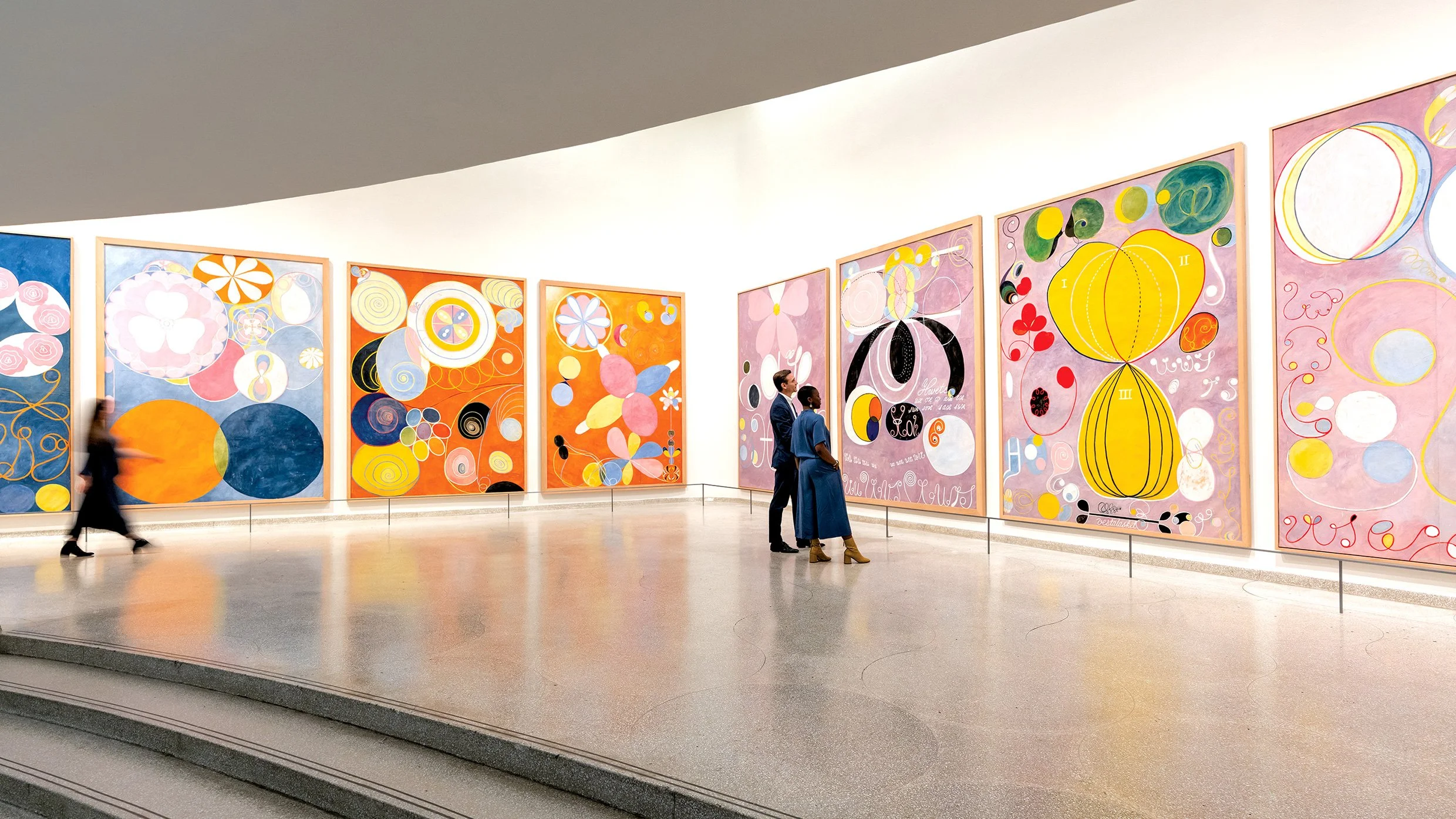
Hilma af Klint: Paintings for the Future, Guggenheim Museum NY, 2018
The woman who had been left out of the manuals was no longer a footnote. She was a revelation, a revolution.
In my opinion, the growing recognition of Hilma af Klint is one of the greatest plot twists in contemporary art history.Because it is not just the rediscovery of an artist: it is the collapse of a narrative.
It forces us to ask: who gets remembered? Who gets called a genius? Who gets placed at the beginning of a movement? And how many women were creating futures that the present did not know how to archive?
I find her recent fame genuinely moving, not because fame is the point. I like to think that af Klint probably would have found our obsession with visibility slightly ridiculous. But because there is something deeply satisfying in watching history correct itself, even if late. There is something beautiful in seeing a woman who painted for the future finally meet the audience she believed would one day exist.
And now, that audience includes us.
So, if you happen to be in Paris, I truly suggest you go see her exhibition at the Grand Palais.
(You can learn more about it here: Hilma af Klint exhibition )
It is one of those shows that does not just ask you to look. It asks you to slow down. To enter a different rhythm, a different world. To stand in front of color, symbol, scale, and silence, and let yourself feel a little less attached to the obvious.
The exhibition is beautifully curated, and seeing her works in person makes you understand why images on a screen will never be enough. The paintings are large, strange, luminous, and alive. They have that rare quality of making you feel like you are looking at something ancient and futuristic at the same time.
A secret that waited a century to be told.
And somehow, it still feels ahead of us.