Designing Meaning
Born in Torino, Italy, into a family of precious stone traders, Lodovica Gay grew up around gems, material culture, and the quiet codes of fine jewellery. What began as familiarity evolved into a design language of her own: one shaped by formal training in Jewellery and Accessories Design at IED Turin, refined through experience in Paris, and grounded in a clear sensitivity to craftsmanship, proportion, and personal storytelling.
Today, her work moves between elegance and intimacy, with bespoke commissions at the heart of her practice.
For Lodovica, designing a jewel is never just about form: it is about interpretation. About understanding a person, translating emotion into reality, and creating pieces that feel singular from the very beginning.
We spoke with her about entering the industry, the value of listening in bespoke design, and the story behind one of her most memorable creations: the Keshi Ring.
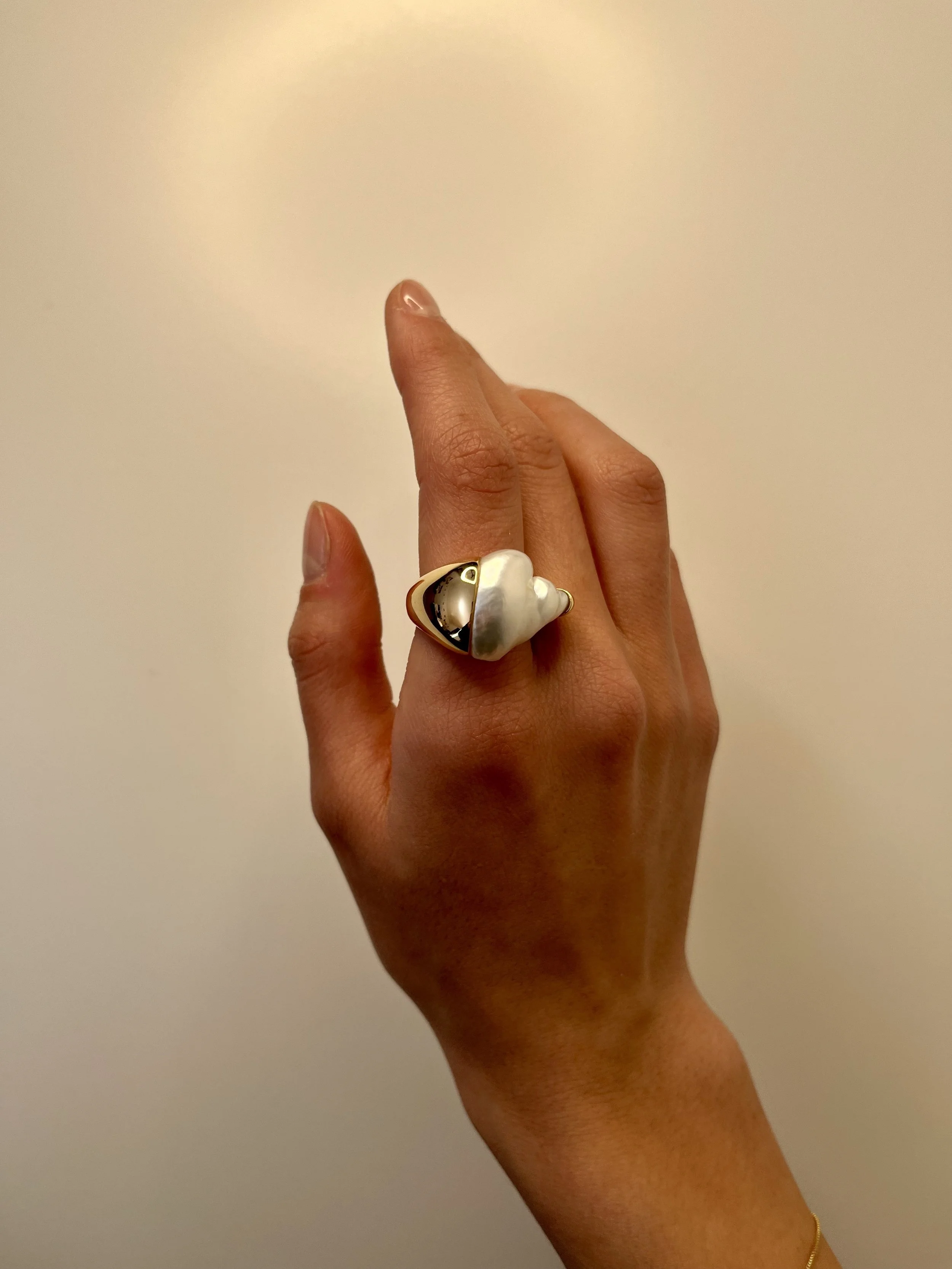
The Keshi Ring by Lodovica Gay
Your work feels both highly aesthetic and deeply personal. What was it like stepping into the professional world after your studies, and how do you experience working on private commissions today?
“What I find most rewarding is being able to turn something I have always felt deeply connected to into a real profession. Jewellery has never felt distant to me. It has always been a world I understood intuitively, but studying design gave me the tools to approach it with greater structure and intention.
Working with private clients adds another layer entirely. A bespoke project is never only about creating something beautiful. It is about understanding what someone wants to express, even when they do not yet have the words for it. That interpretative dimension is what I find most fascinating. There is a strong emotional element, of course, but also a great deal of rigour.”
When a private client comes to you for a bespoke piece, where does the process really begin?
“It always begins with conversation. Sometimes there is a specific occasion — an anniversary, an engagement, a significant gift. Sometimes there is already a stone, or a reference, or an initial idea. But very often, what exists at the beginning is only a direction.
My role is to give that direction more clarity. I ask many questions, because listening is essential in this kind of work. I need to understand not only what the client likes, but who the piece is for, how that person carries themselves, what kind of presence they have, what kind of jewellery feels true to them.
That is what allows the project to become genuinely bespoke. Otherwise, it remains only customised on the surface.”
So listening is not just part of the process — it is the foundation of it.
“Yes, absolutely. I think a designer needs to develop a real discipline of listening. A jewel can be technically perfect, but if it does not resonate with the person it is intended for, then something is missing.
I often ask clients to describe the recipient in detail — their style, their character, their taste, even the way they move. These elements help me shape a proposal that feels more precise and more personal. Budget is naturally part of the process as well, because it helps define the project in a way that is coherent and well balanced, while still protecting the quality of the final piece.”
Is there one project that, for you, captures this approach particularly well? Lodovica Gay:
“Yes — the Keshi Ring is certainly one of them.”
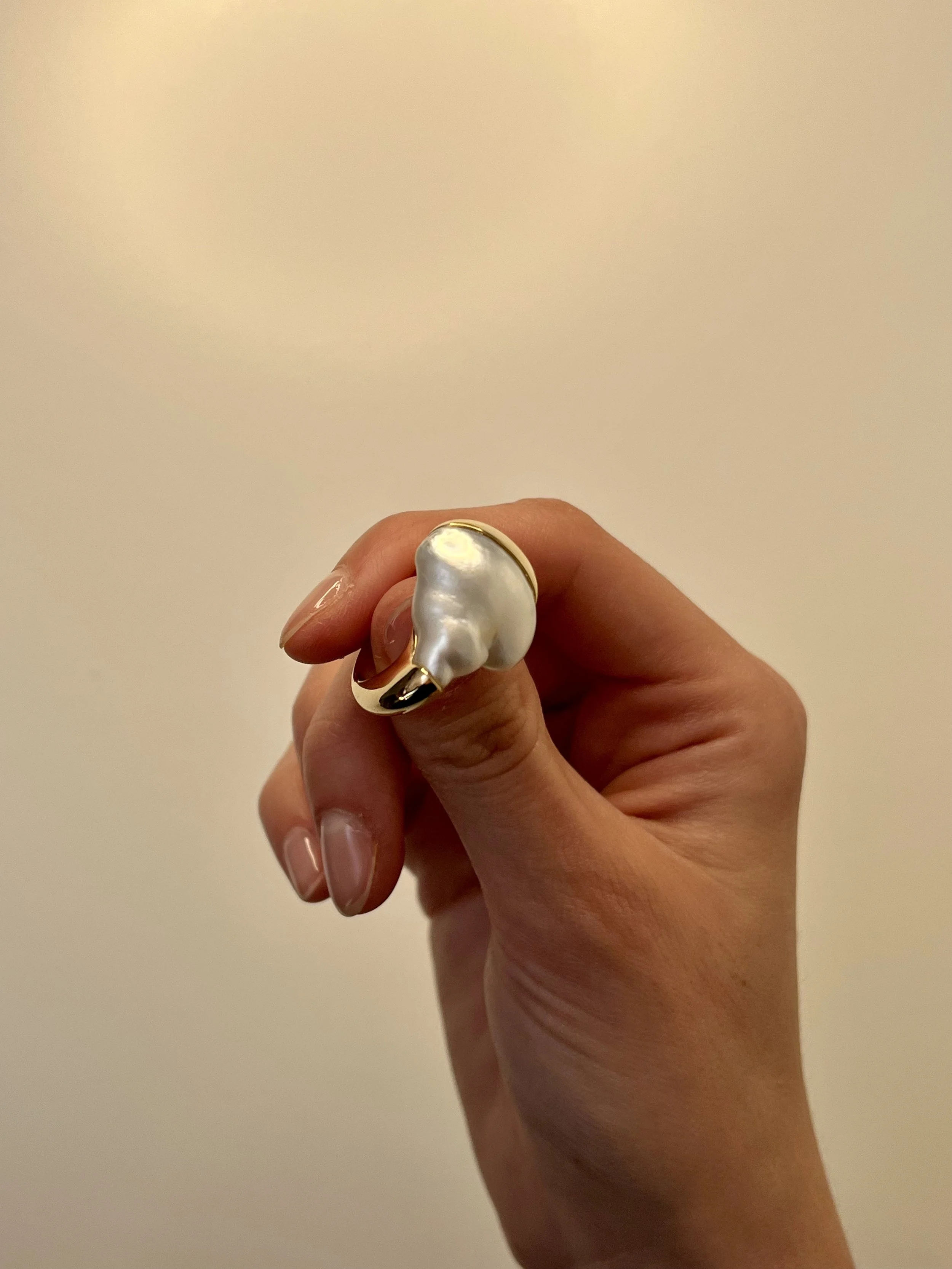
The Keshi Ring by Lodovica Gay
Tell us the story behind it.
“A client came to me wanting to create a gift for her mother to celebrate her thirtieth wedding anniversary. She wanted something that would feel meaningful, not simply beautiful. That immediately changed the way we approached the project.
We started from the symbolism of the occasion itself: pearl is traditionally associated with thirty years of marriage, which gave us a strong narrative foundation. From there, I returned to the question that matters most to me: who is the woman who will wear this piece?
The client described her mother as someone with very distinctive taste — someone who values uniqueness, who is drawn to jewellery with character, and who would never want something too obvious or conventional. As soon as I heard that, I thought of Keshi pearls.”
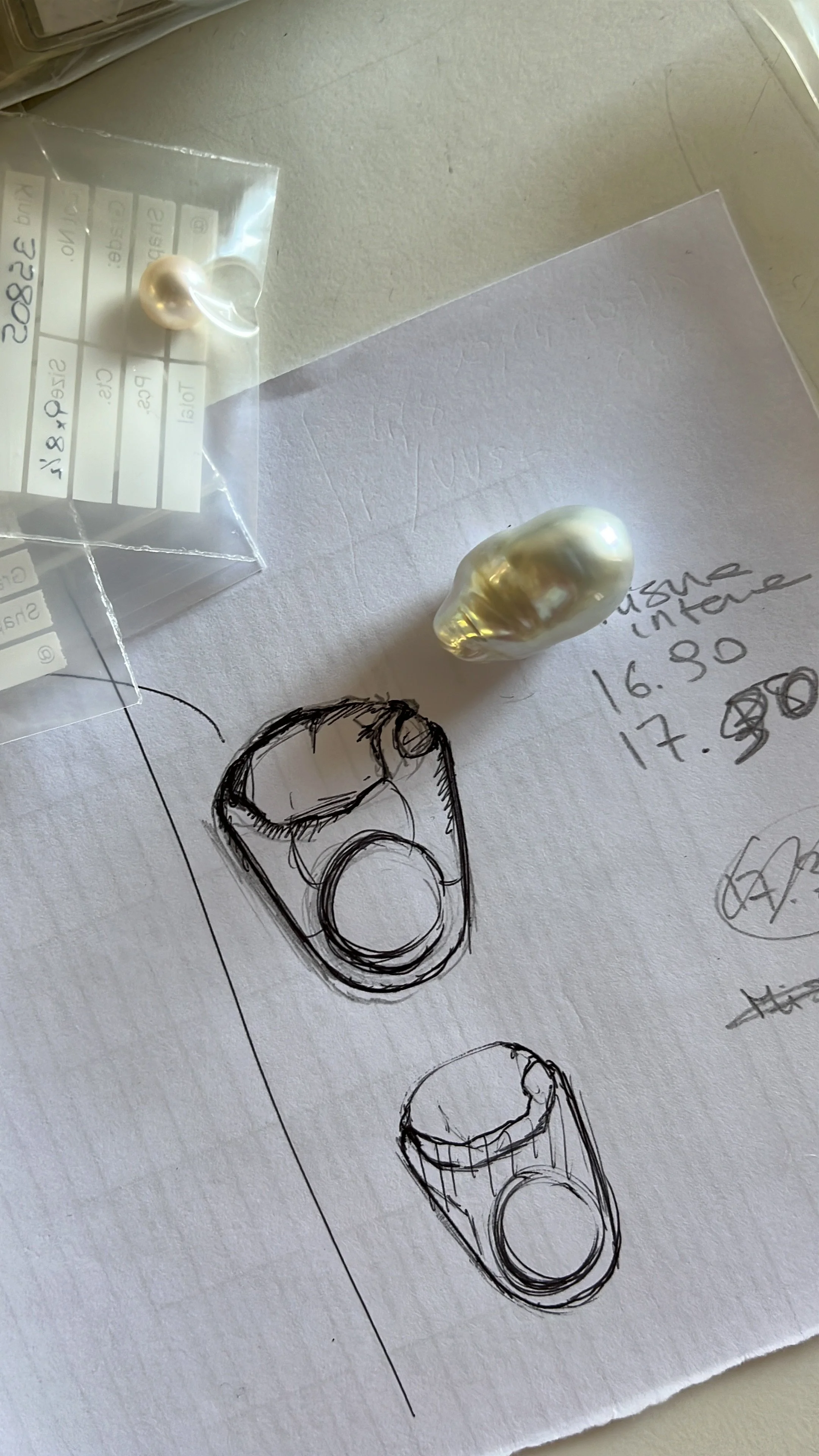
Keshi Ring Sketches by Lodovica Gay
What made Keshi pearls the right choice?
“They have an extraordinary presence. Keshi pearls are non-nucleated, formed entirely of nacre, and because of that, each one is completely unique. They are irregular, luminous, organic: never identical, never standardised.
What interested me was the way their singularity reflected the personality we were trying to honour. They felt refined, but also expressive. Unrepeatable, in a way. And that made them the perfect starting point.”
And from there, how did the design evolve?
“Once we had identified that direction, I selected a range of pearls, each with its own shape, tone, and character. I then began sketching different possibilities, always thinking about how the ring could respond to the pearl rather than overpower it.
That is an important part of my approach: I do not believe in offering options for the sake of it. I prefer to build a coherent set of proposals, each one developed with intention, so that the client can gradually recognise themselves in a form, in a balance, in a particular aesthetic language.
In a project like this, design becomes a process of refinement.You move closer and closer to the piece that feels inevitable — the one that could only have been this.”
What made Keshi pearls the right choice?
“They have an extraordinary presence. Keshi pearls are non-nucleated, formed entirely of nacre, and because of that, each one is completely unique. They are irregular, luminous, organic: never identical, never standardised.
What interested me was the way their singularity reflected the personality we were trying to honour. They felt refined, but also expressive. Unrepeatable, in a way. And that made them the perfect starting point.”
And from there, how did the design evolve?
“Once we had identified that direction, I selected a range of pearls, each with its own shape, tone, and character. I then began sketching different possibilities, always thinking about how the ring could respond to the pearl rather than overpower it.
That is an important part of my approach: I do not believe in offering options for the sake of it. I prefer to build a coherent set of proposals, each one developed with intention, so that the client can gradually recognise themselves in a form, in a balance, in a particular aesthetic language.
In a project like this, design becomes a process of refinement. You move closer and closer to the piece that feels inevitable — the one that could only have been this.”
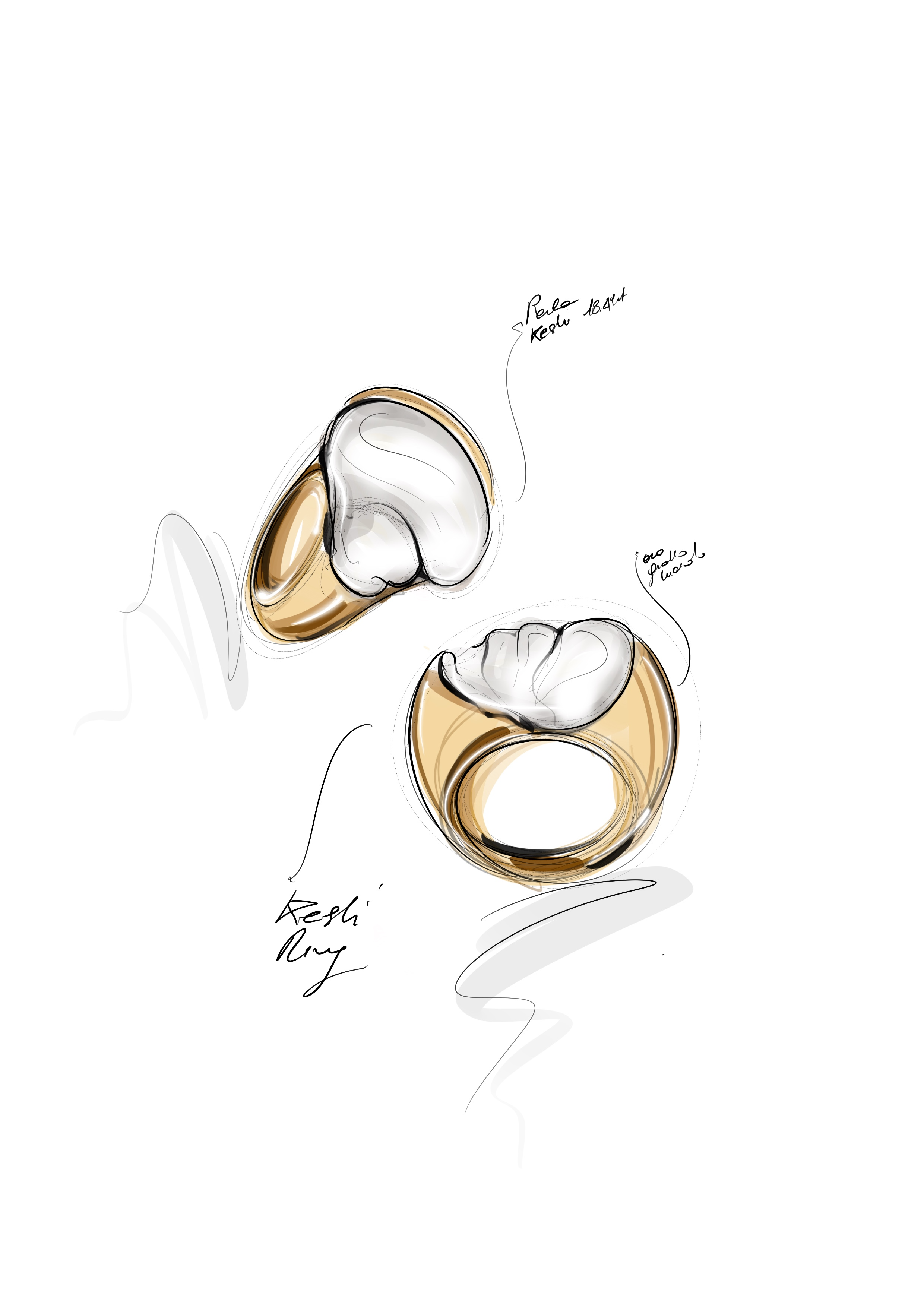
Keshi Ring Design by Lodovica Gay
There is something very elegant in that idea: that the final jewel is discovered through precision rather than excess.
“Yes, I think that is true. For me, luxury is closely tied to intention. It is not about adding more, but about arriving at the right balance: materially, visually, emotionally.
That is what I am always looking for in bespoke work: a result that feels sophisticated, but also deeply connected to the person and the story behind it. When that happens, the jewel becomes more than an object. It becomes something quietly intimate.”
In Lodovica Gay’s world, bespoke jewellery is not simply decorative — it is interpretative. A practice shaped by listening, craftsmanship, and emotional precision, where luxury lies in nuance, individuality, and the rare feeling that something has been made exactly as it should be.