The “Rosewood” Chair
A message on the ongoing rosewood crisis and the responsibility of young designers to create meaning and transformation through design.
For this design project I collaborated with my close friend and designer, Sofia Vargas. Sofia creates organic designs using wood, ceramics, textiles and paper and she enjoys experimenting with light for products. My work is more structural and geometric with emphasis on shapes using metals for both products and furniture. We have our differences, but fundamentally our design process is similar. We both start with research and media exploration so we can create an interesting and compelling storyline for our designs. Design requires context, a narrative and connections to resonate with people, if not, it lacks something meaningful: your own personal energy and your intentions for the world. Charles Eames said it best in 1961:
“Eventually everything connects - people, ideas, objects, etc…the quality of the connections is the key to quality per se.”
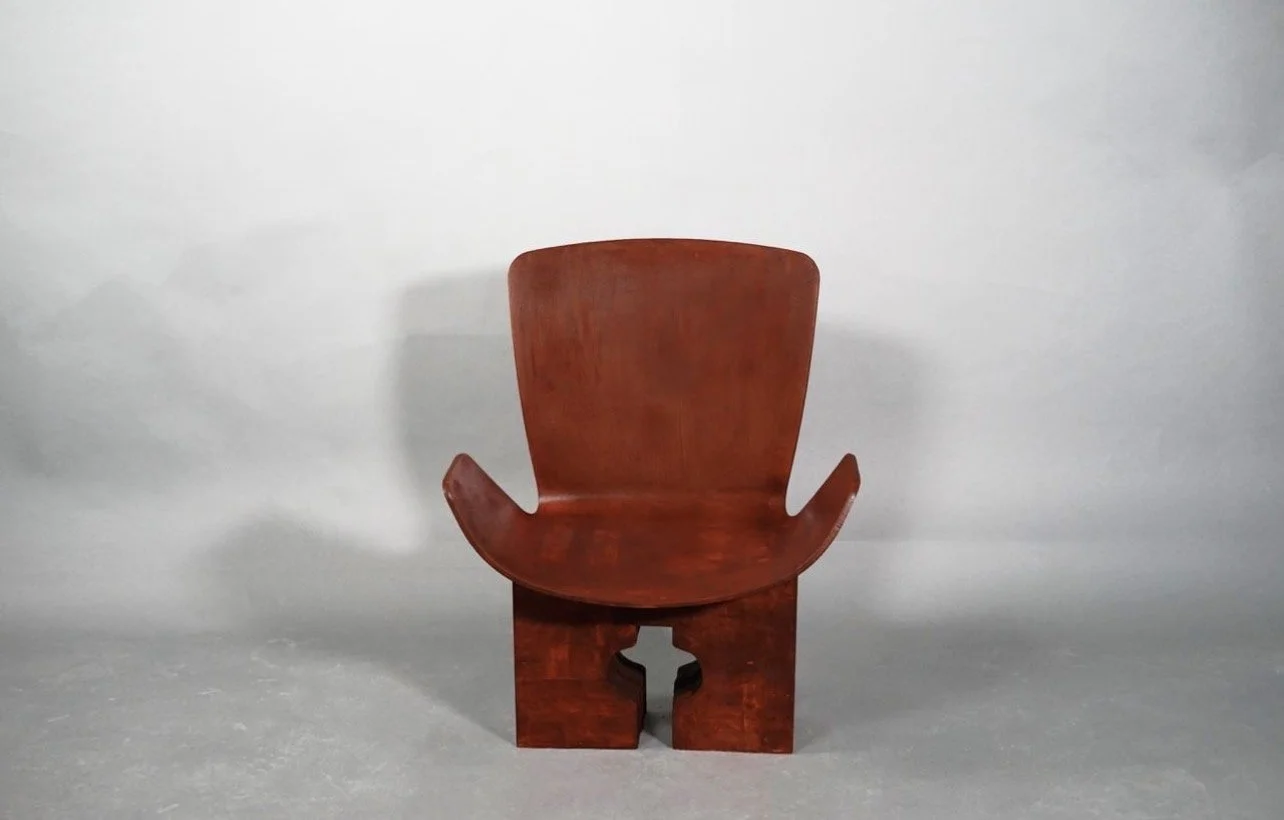
The “Rosewood” Chair by Alice Semenenko & Sofia Vargas
Why is rosewood in the chair title in quotation marks? Well because it is not actually made of rosewood, it is plywood coated with a rosewood stain. In this article I will explain how researching Charles and Ray Eames helped us to discover illegal rosewood trading, which is why actual rosewood is banned for furniture production. The chair is made from 100% waste plywood to support upcycling in the furniture industry. Sofia and I wanted to display that you can have beautiful rosewood furniture without perpetuating a cycle of environmental and social damage.
We got to the rosewood story in an interesting way, and it started at the library researching Charles and Ray Eames. Our brief for this project started by choosing an iconic furniture piece and analysing the materials within the object. Sofia and I chose the iconic Charles and Ray Eames Lounge chair and Ottoman (1956).
The Eameses are known for innovation, with experiments of bending plywood and plastic moulding. They are a husband-and-wife team, Charles Eames worked on the architectural and structural side of production and Ray Eames worked on the artistic and creative side. The blending of innovation and artistry led to furniture, which is timeless, functional and beautiful. My favourite objects they made are “Plywood Sculpture” (1943) and “Plywood Elephant” (1945) because they represent the Eameses so well: it is art mixed with genius engineering.
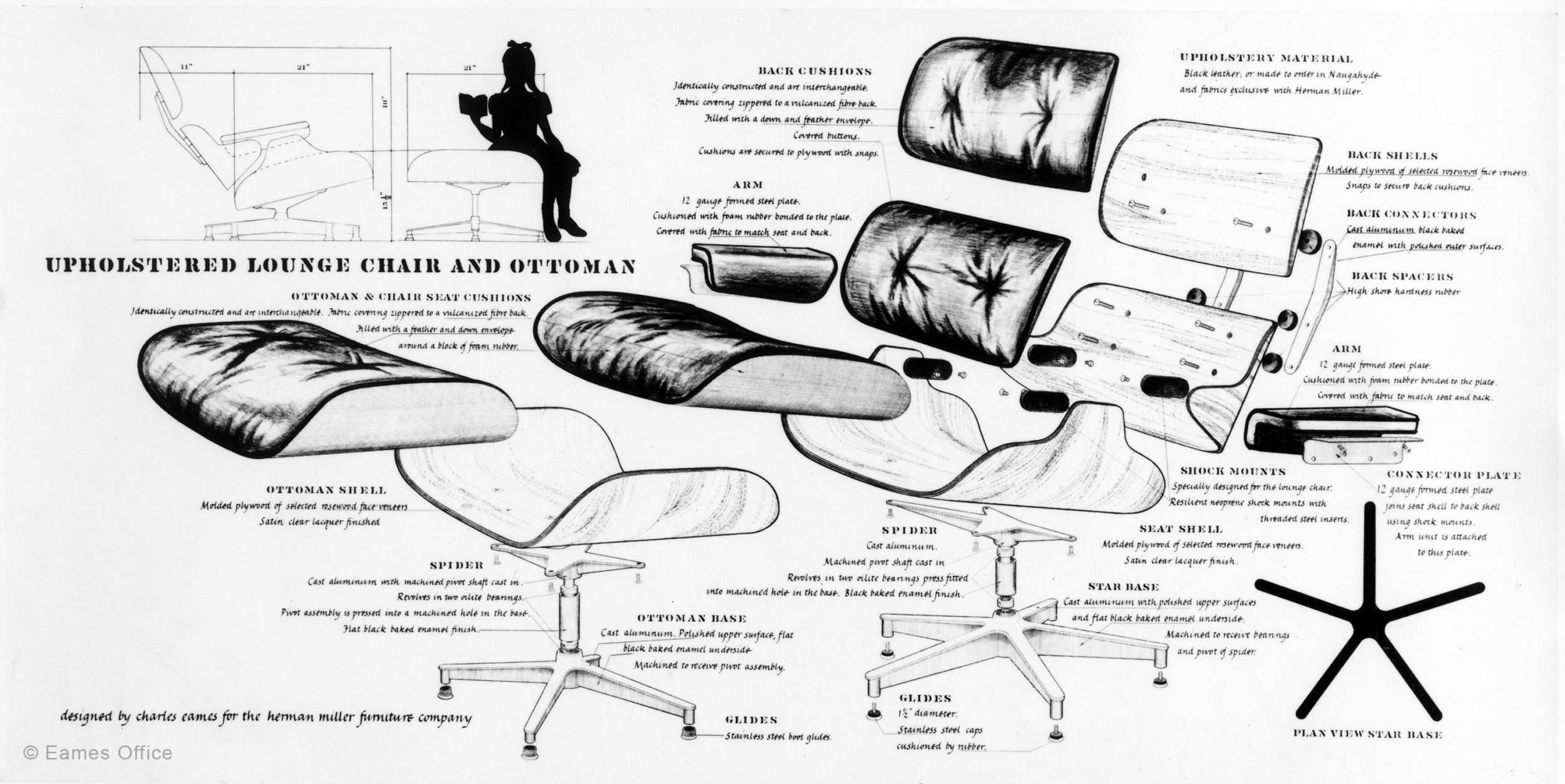
Sofia and I got immersed into the Eames world and we discovered many Eames advertisements for the original Lounge Chair in 1956. A product breakdown from Eames Office labels the original plywood as rosewood, and I had never explored this specific type of wood. We were then hit with articles and stories and research papers about the damage the rosewood trade has inflicted on local ecosystems, tree farmers and international trade. Sofia and I both realized how important this story was, and it had to be told in our design.
Rosewood is the most trafficked natural species on the planet due to its red colour and its scent, which is sought after to create high quality furniture and perfumes especially in China. It is illegal to trade in rosewood now because of corruption, and of the danger to local ecosystems where rosewood is being continuously cut down to suit demand. (Ong and Carver, 2019) Historically in Belize, British colonialists already began to extract local rosewood trees and took control over the land of local farmers to support the British economy. (Wainwright and Zempel, 2018) Currently in Belize, rosewood is still being illegally traded and in Madagascar rosewood logs are hidden in lakes which are turning red because of the rosewood colour. Local traffickers are continuing to illegally ship and cut down large amounts of rosewood. Few forests of natural rosewood remain. (Ong and Carver, 2019) In Mozambique, illegal rosewood trade even supplied money to fund a militant group that is fighting against the government. A BBC investigation found that “1000 football pitches of forest” are being cut down each day to continue to fund violence. (Henshall, 2024) Rosewood trafficking involves corruption and greed which has escalated the situation to crimes against humanity.
As designers in our generation, it is our responsibility to understand the significance of every piece of material we work with.
It is no longer acceptable to use a material for aesthetics or status, we must understand its life cycle, if it can be recycled, or reused or disassembled. Look at plastic, it was once a wonder material for the future, and now only 9% is being recycled globally (UNDP, 2023) and it takes 20 to 500 years to biodegrade, so it is stuck in landfills. (WWF, 2025) Tony Fry in “Design Futuring” (2018) discusses the harmful effects of industrialization, and that we are at a point in our world where we must stop “defuturing” by destroying resources and our planet to keep creating more items. He argues that designers are the key to creating positive change since we are developing new objects for our world. We have the power to control what materials we use and how long they can last.
Sofia and I understood our responsibility to enlighten others about the illegal trade of rosewood and to create a chair that is beautiful, high quality and sustainable without new extraction for materials but using what we already have.
“In our endeavour to sustain ourselves in the short term, we collectively act in destructive ways towards the very things we and all other beings fundamentally depend upon”
Tony Fry, Design Futuring, 2018
“In our endeavour to sustain ourselves in the short term, we collectively act in destructive ways towards the very things we and all other beings fundamentally depend upon” Tony Fry, Design Futuring, 2018
With our narrative complete, Sofia and I began the design development and searching for materials. We wanted to honour the legacy of the Eameses work by using plywood in our design, so we collected and used dozens of waste plywood planks from the wood workshop. We found and used an old, discarded seat shell with a backrest that was also moulded plywood, and the curve on the seat reminded us so much of the Eames Lounge chair we had originally researched. Our materials were set, but they were old, dirty and needed a lot of work.
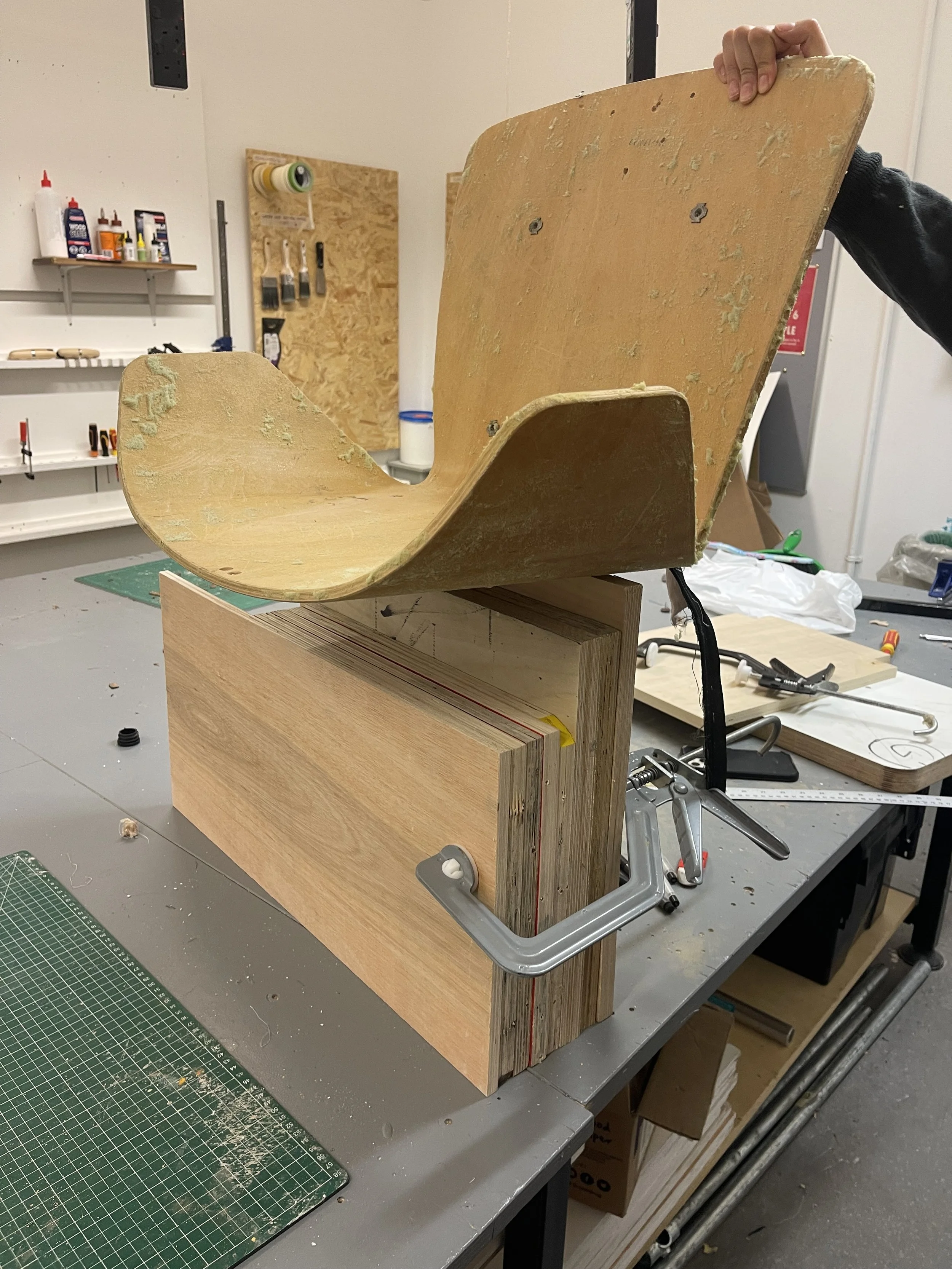
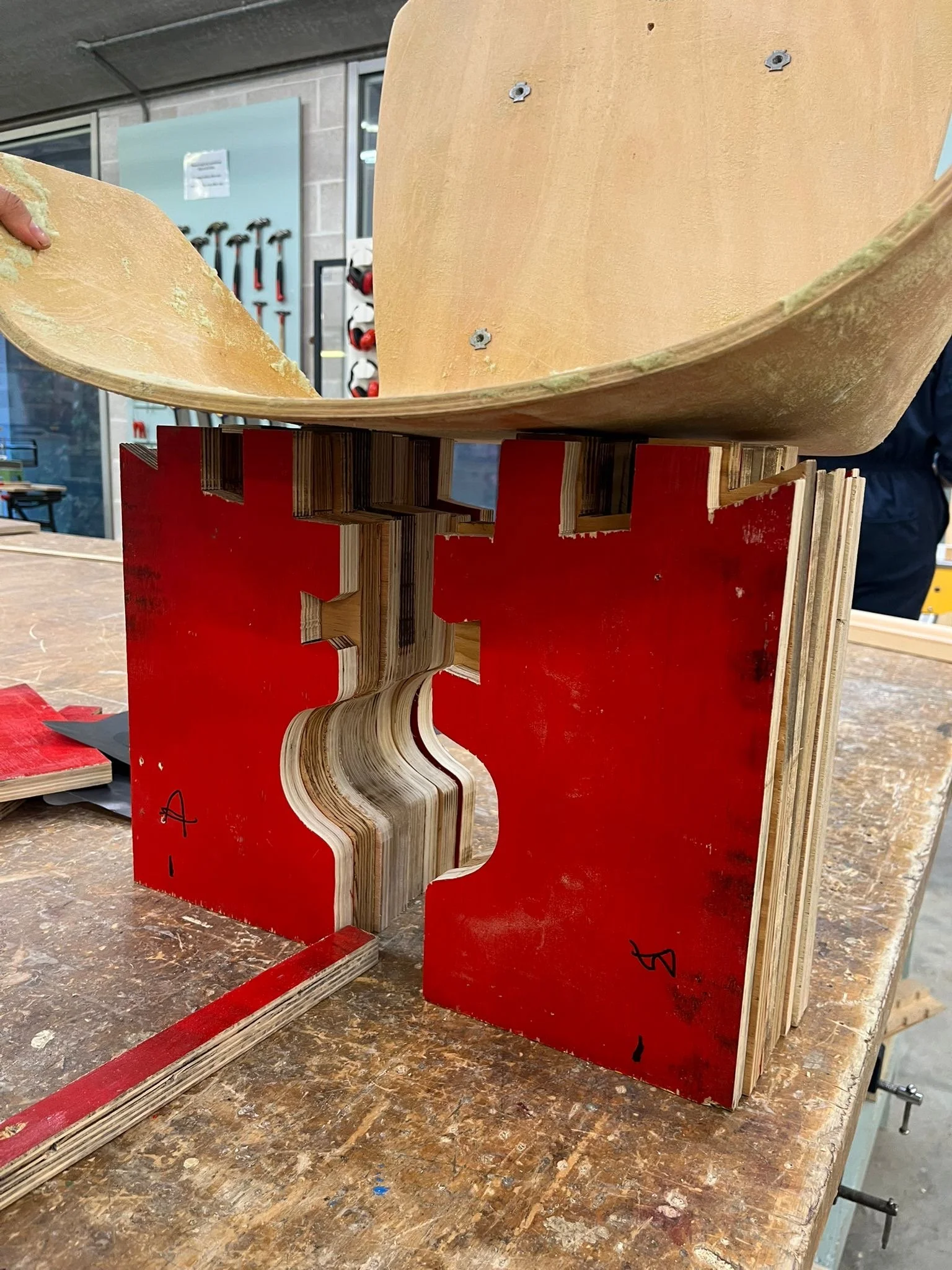
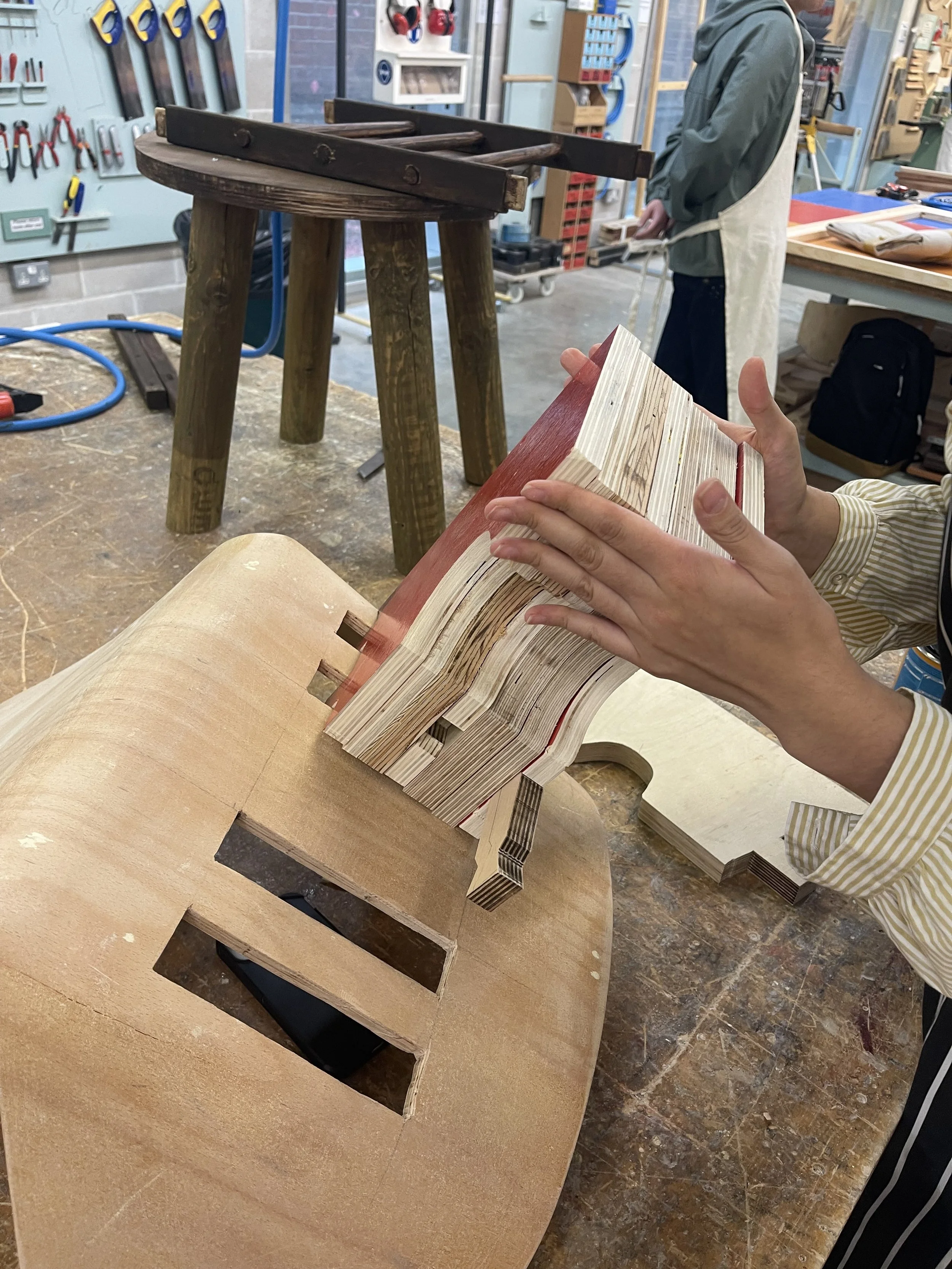
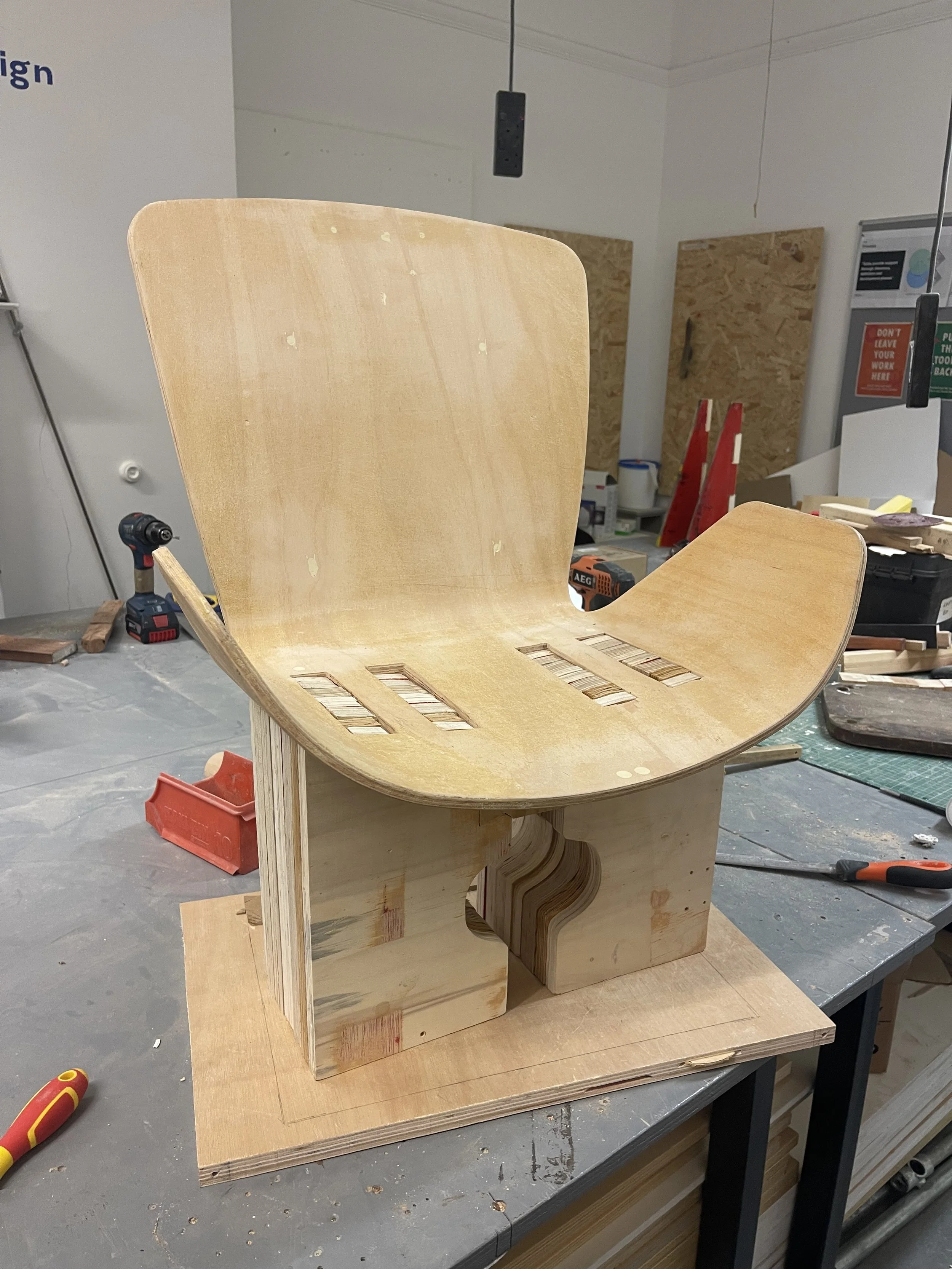
Sofia and I wanted to reference the first plywood prototypes that the Eameses developed when bending plywood seats. They cut a beautiful organic shape in the middle of the plywood backrests, and we thought this could develop into an interesting shape for the legs of our chair. The Eameses weren’t afraid to experiment with new ideas, which motivated us to explore plywood further by making a huge block of plywood as the legs of the chair. We sketched ideas and options for the legs and together we decided on a semi-circle design.
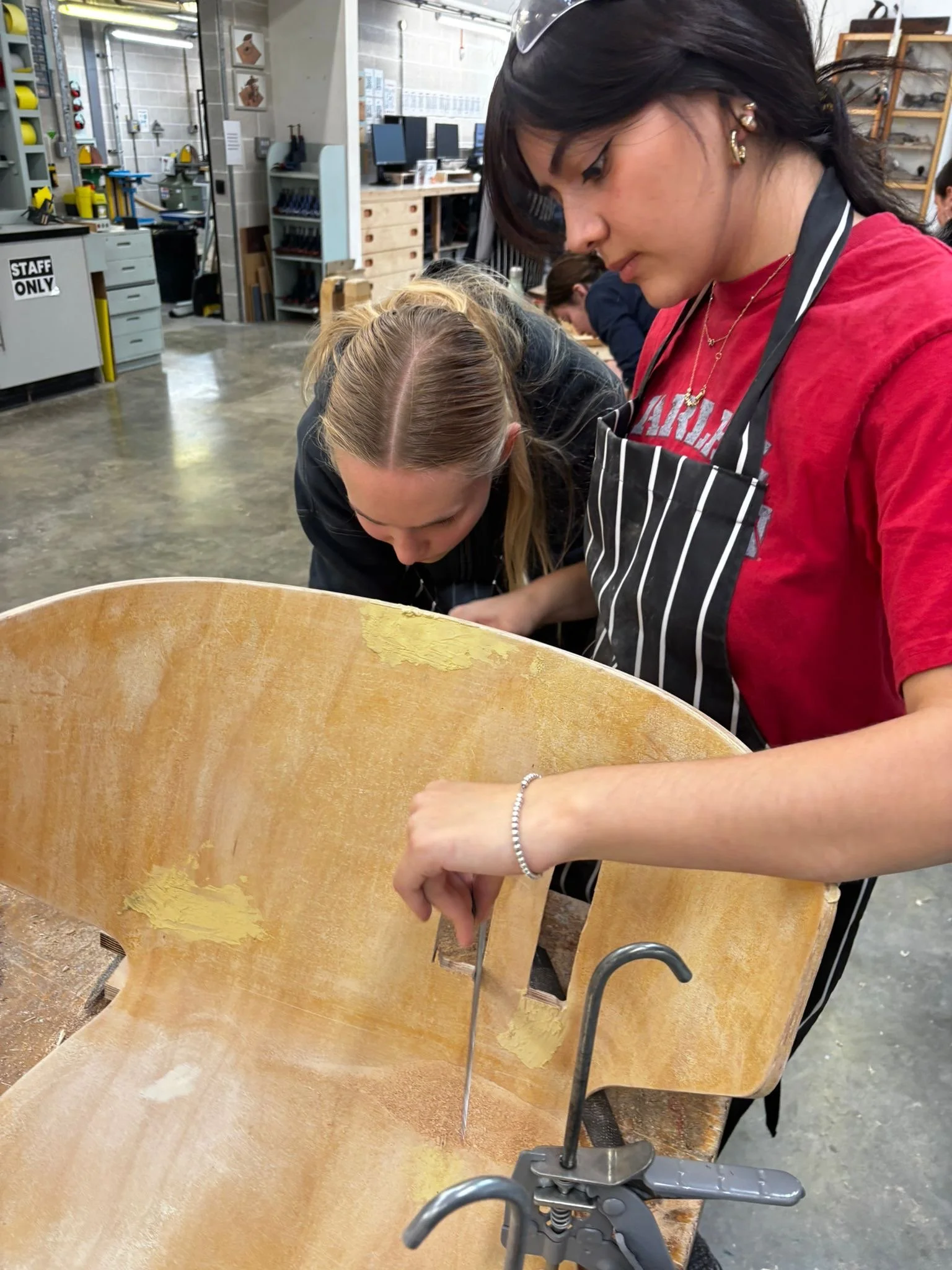
Sofia and I made everything ourselves in the workshop: we cleaned and sanded the components, we created the massive plywood block chair legs by cutting each plank to the same curvy shape, we joined the seat with the legs and added the rosewood stain to give it the beautiful red hue. We only had two weeks before we had to display the piece at a showcase, but we worked so hard because were so determined to tell our story.
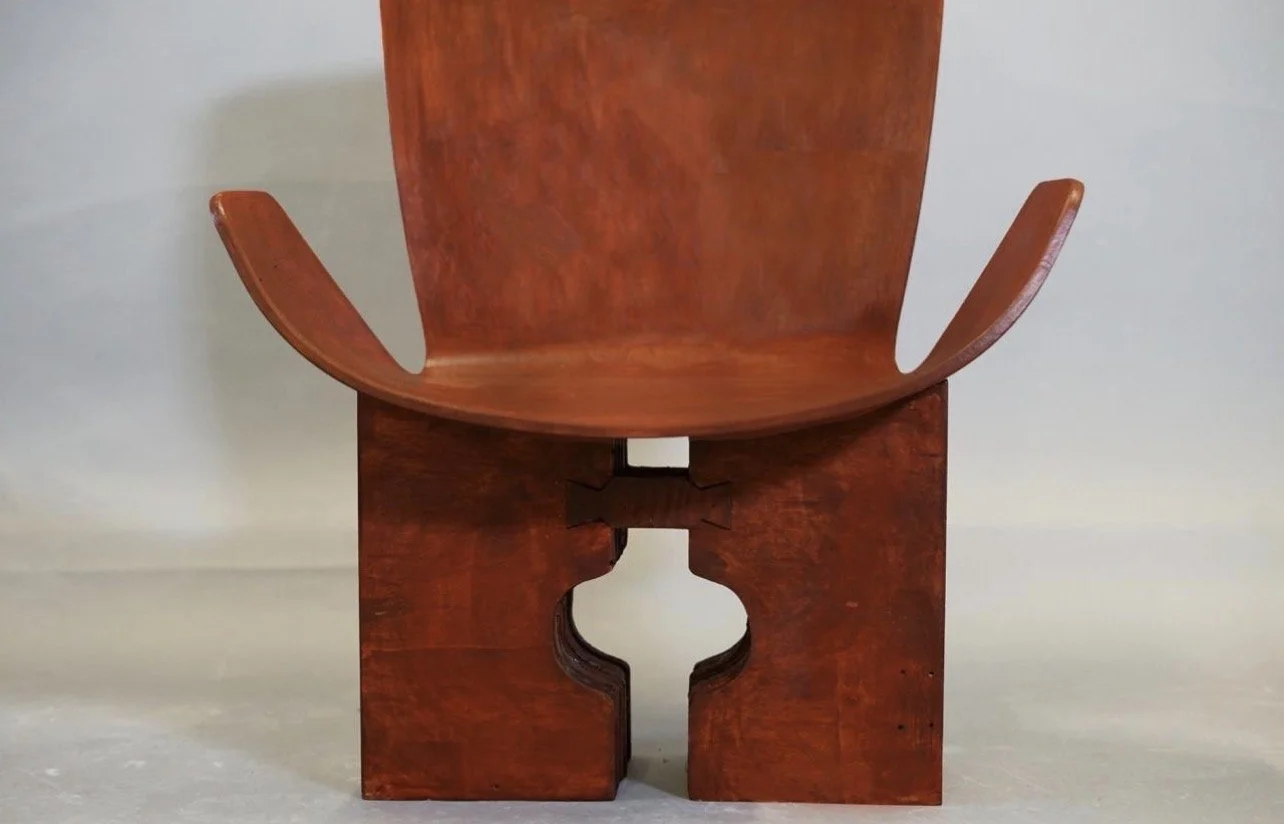
The “Rosewood” Chair by Alice Semenenko & Sofia Vargas
With the “Rosewood” chair Sofia and I transformed old, discarded plywood into a functional and sculptural chair which is currently standing beautifully in my bedroom.
It is a comfortable nook in my space, it physically helps to support my weight, my clothes and symbolically it supports my message of hope for the world. There are so many waste streams, but so much potential for change. Sofia and I chose one narrative to share with the world, but I am sure each of you have your own passions and your own desires to create change in any artistic medium.
Designers and artists can be the alchemists which can help transform waste into artifacts – so share your ideas, your narratives, always: but please do it with care.
A huge thank you to Sofia Vargas for contributing all her amazing graphic design posters for this article.